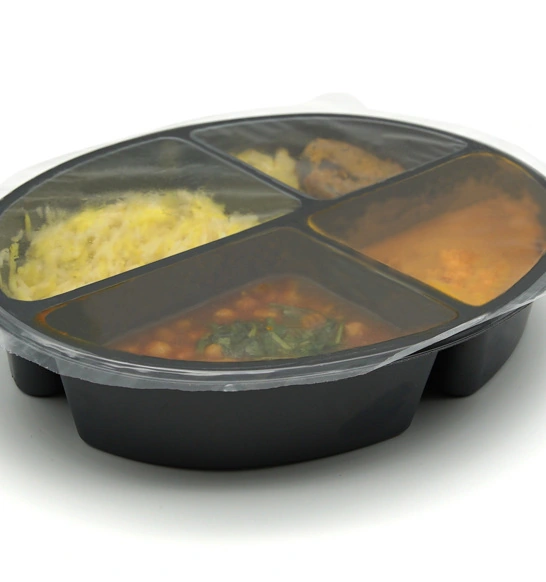
A pasta tray, a meal with sauce and a multi-compartment menu need an appropriate combination of tray, film and process. Selection must also consider how each portion is filled, conveyed and presented.
Packaging format example; compatibility requires product and material validation.
Choosing the tray and lidding film
Define external dimensions, depth, compartments and portion weight. Check film compatibility with the tray material and intended opening method. If the customer will reheat the product, validate the materials and usage instructions; do not assume that every pack is suitable for an oven or microwave.
Semi-automatic or automatic tray sealing
The NEX-450M/2 provides a starting point for manual tray loading with an automatic evacuation, gas flushing, sealing and cutting sequence. For integrated tray handling, explore the NEX-450A and NEX-350AZ. The choice depends on filling speed, formats, staffing and the output that needs to be sustained.
Seal-only and modified atmosphere packaging
Sealing without changing the atmosphere and MAP serve different processes. Select the configuration for the recipe, temperature and intended storage conditions. Sauce or food particles on the rim can affect the seal, so assess filling and carry out sealing trials using the actual product.
Information needed to select your machine
Send a tray sample or drawing, recipe or food characteristics, filling temperature, portion weight, number of formats, target output and coding or labelling needs. These details help evaluate the complete line.
Tray geometry, sealing rims and tooling must be compatible. Confirm the design with the technical team before choosing a machine.
Can I change tray formats during the day?
Models with interchangeable tooling can be evaluated for multiple formats. Moulds, settings and changeover times must be specified for the selected configuration.